
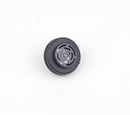


SRF01 - The Worlds Smallest Single Transducer Ultrasonic Ranger
Devantech
World beating performance - the SRF01 employs Devantech's 2nd generation AutoTune technology which allows ranging all the way down to zero on a single transducer sonar.
Technical data
| SRF01 | |
|---|---|
| Range (Industrial spec') | 18 cm ... 6 m |
| Range (Hobby spec' after auto-calibration) | 0 cm ... 6 m |
| Supply voltage | 3.3V ... 12V DC |
| Current (typical) | 25 mA |
| Weight | 2.7 g |
| Units | cm/inch |
| Frequency | 40 kHz |
| Interface | Single Pin Serial Communication |
Connections

Single Pin Serial Communication
Serial data is 1 start, 1 stop and no parity bits. Serial data is a TTL level signal - It is NOT RS232. Do not connect the SRF01 to an RS232 port - you will destroy the module! Communication with the SRF01 is with both serial input and serial output on a single pin. The SRF01 will be listening at all times except when it is actually sending data, and will go back to listening as soon as its finished. To communicate with the SRF01, you simply need to send a "break", followed by two bytes, the address of the SRF01 (factory default is 1) and the command. A "break" is just a low level for 12 bit times or longer. 1.5mS or more will be fine. It is used to synchronize transfers on the 1-wire serial bus. The default shipped address can be changed by the user to any of 16 addresses 1, 2, 3, 4, 5, 6, 7, 8, 9, 10, 11, 12, 13, 14, 15 or 16, and therefore up to 16 sonar's can be used. Note - this range is different to the SRF02 which has addresses 0-15. The reason is that for specific commands only all SRF01's regardless of their programmed address, will respond to address 0. This makes it easy to start all SRF01s ranging at the same time.
Mounting the SRF01

A rubber grommet is supplied to mount the SRF01. To use this make a 20mm cutout in your panel and fit the grommet. The SRF01 will then snuggly push into the hole in the grommet. Maximum panel thickness is 1.7mm.
Accuracy
Devatech quotes 3-4cm. It is normally better than this, however so many factors affect accuracy that the manufacturer won't specify anything better than this. The speed of sound in air is approx. 346m/S at 24 degrees C. At 40KHz the wavelength is 8.65mm. The sonars detect the echo by listening for the returning wavefronts. This echo has an attack/decay envelope, which means it builds up to a peak then fades away. Depending on which wavefront is the 1st to be strong enough to be detected, which could be the 1st, 2nd or even 3rd, the result can jitter by this much. Another effect which limits accuracy is a phasing effect where the echo is not coming from a point source. Take a wall for example, the ping will bounce off the wall and return to the sonar. The wall is large, however, and there will be reflections from a large area, with reflections from the outside being slightly behind the central reflection. It is the sum of all reflections which the sensor sees which can be either strengthened or weakened by phasing effects. If the echo is weakened then it may be the following wavefront which is detected - resulting in 8.65mm of jitter. It is possible to see changes of distance as small as mm but then get cm of jitter.
Manufacturer's data
Technical Specification - link to the manufacturer
FAQ - link to the manufacturer
Contact us
Obsolete item
This item is not available any more. Some components might no longer be manufactured or there is an improved successor model.
Share
About ROBOT ELECTRONICS
ROBOT ELECTRONICS is a brand by English manufacturer Devantech Ltd., based in Norfolk. Product range comprises sensors, in particular ultrasonic or compass, servocontrollers as well as small robot drive systems or relay modules with various interfaces. Sensors are produced in England and are of consistently high quality.
More from ROBOT ELECTRONICS